.svg)
.svg)
Retail Media Is Moving Into the Store. Execution Will Decide Its Value
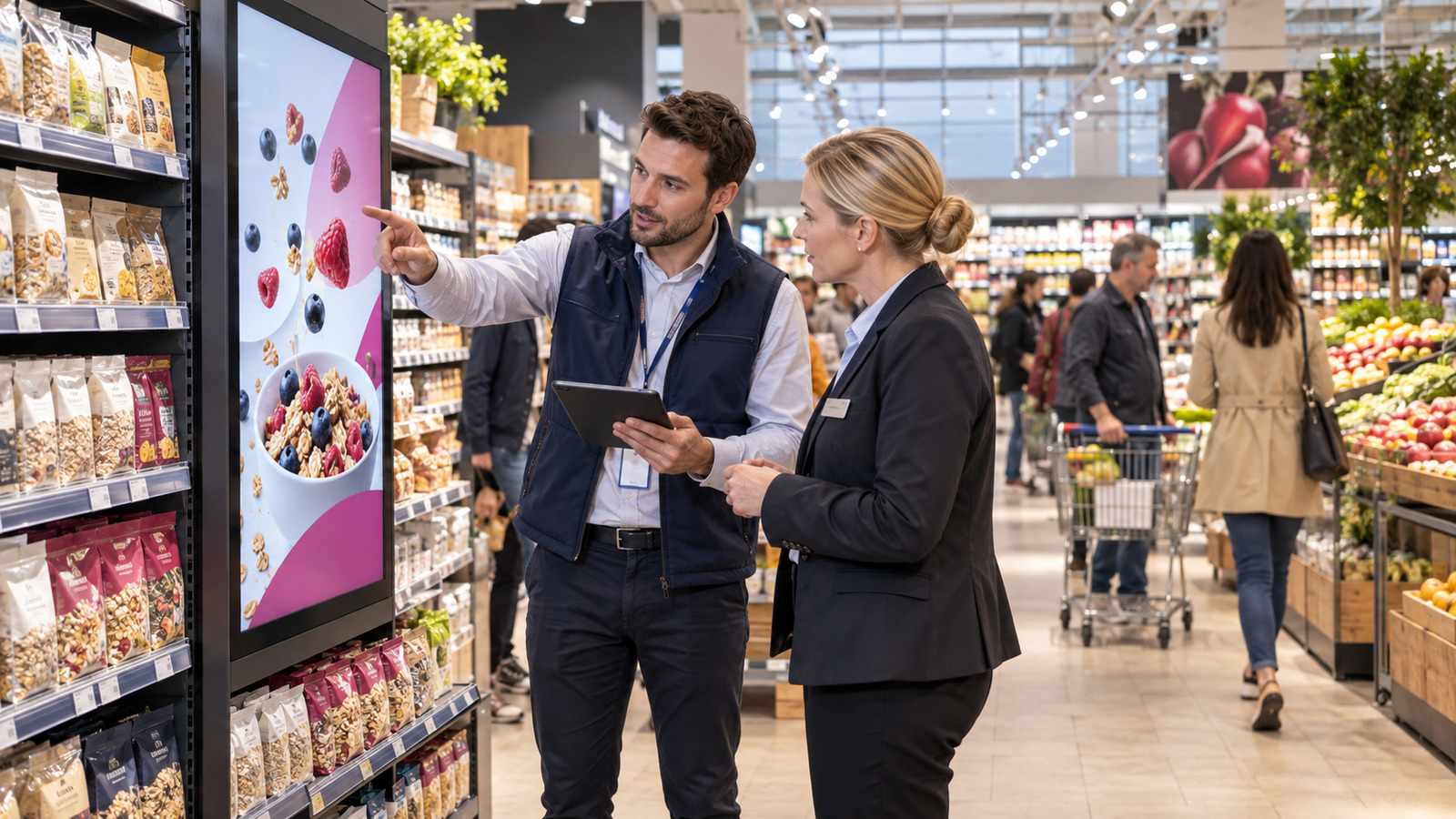
Retail media has grown quickly around retailer websites, apps and first-party audiences. The next challenge is connecting that investment with the physical store, where availability, placement, screens, fixtures and staff behaviour determine whether a campaign is actually visible to the shopper.
The market is maturing
IAB Europe’s 2026 Retail Media Hub shows an industry focused on common definitions, comparable measurement, certification, in-store incrementality and the organisational change needed to support growth. Advertisers increasingly need evidence of what was delivered and how it influenced outcomes.
Source: IAB Europe Retail Media Hub, current resources and standards, accessed 6 August 2026 |https://iabeurope.eu/retail-media-hub/ (verified 6 August 2026)
That creates a field execution question as much as a media question. A booked placement has no value if the screen is offline, the product is unavailable or the display is obstructed.
In-store media has more moving parts
Digital content, hardware, power, planograms, stock and promotional materials need to align. Retailer access and store-level interpretation can also change the result.
Campaign design should therefore include a physical acceptance standard, not only an audience and media plan.
Measurement must connect exposure and reality
Retail media reporting may show that content was scheduled, but brands also need to know whether it was displayed correctly and whether the promoted product could be purchased.
Independent or structured field validation can provide timestamped evidence, screen status, share of space, availability and exception reasons. This does not replace sales or audience measurement; it explains the conditions behind it.
SIG’s role in the retail media chain
SIG supports audits, merchandising, screen and display installation, maintenance, data capture and remediation across European retail estates.
By connecting media delivery with store reality, brands and retailers can protect campaign value and build the operational evidence needed for a more accountable in-store retail media market.
What brands and retailers should do next
Priority 1: Include physical delivery standards in the media brief.
Priority 2: Validate screen uptime, content, placement and promoted-product availability.
Priority 3: Connect field evidence with audience and sales reporting.
Priority 4: Create a fast remediation path for high-value campaigns.
What this means for brands
The central lesson is that in-store retail media Europe should connect a clear standard with the people, information and ownership needed to deliver it. Brands should define the outcome, involve local experts early and measure the change created rather than relying on activity alone.
For multi-market programmes, consistency and localisation are complementary. Shared governance makes performance visible; local knowledge makes the plan workable. Bringing both together is what turns coverage into reliable retail execution.
How Service Innovation Group can help
Service Innovation Group helps brand improve retail execution through field sales, merchandising, audits, POS installation, maintenance, data collection and real-time reporting. Our UK team works with connected local teams across Europe to provide one joined-up approach with market-level expertise.
If you are planning a UK or European programme, speak to SIG about the operating model, resource and reporting needed to deliver measurable results.
Explore our installation services - HERE
Discuss your campaign - HERE
Frequently asked questions
Why does this issue matter to brands and retailers?
It affects how in-store retail media in Europe translates into customer experience, operational control and measurable commercial performance.
What does Service Innovation Group provide?
SIG supports field marketing, field sales, merchandising, audits, data collection, POS installation and maintenance across the UK and Europe.
Can SIG support multi-country programmes?
Yes. SIG combines local market delivery with connected programme management and consistent reporting across European markets.
How is field activity measured?
Measures are agreed around the objective and can include productive coverage, compliance improvement, photo evidence, issue resolution, conversion and other commercial outcomes.